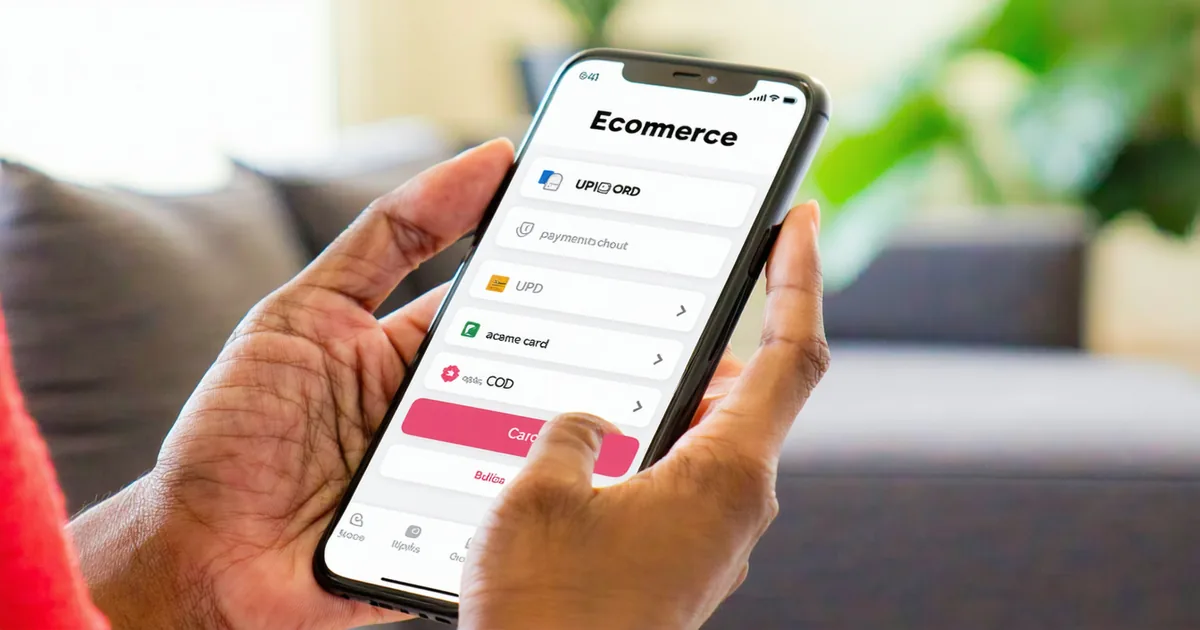
Checkout abandonment is the most expensive problem in Indian D2C — not because abandonment rates are unusually high compared to global benchmarks, but because the specific reasons Indian shoppers abandon are distinct from Western ecommerce patterns, and the standard optimization advice from Shopify blogs and CRO playbooks built on US/UK data does not fully apply here. Applying generic checkout advice to an Indian D2C store frequently improves nothing and occasionally makes things worse.
What follows is a diagnostic walkthrough of seven consistent abandonment points identified across Shopify and WooCommerce stores serving Indian consumers across categories including apparel, beauty, health products, and home goods. Each point is paired with the specific Indian-market context that explains why it matters and what an effective fix looks like.
Point 1: The Payment Method Screen Shows Card First
In India, UPI handles roughly 80% of digital retail transactions by volume. A checkout screen that opens with "Credit Card" or "Debit Card" as the default or first-listed payment method is telling the majority of your shoppers to scroll down before they can pay in the way they prefer. This is a friction tax on every transaction for your highest-frequency customers.
The fix is straightforward: UPI should be the first payment option displayed, with prominent display of QR code and UPI ID fields. Saved UPI handles (phone number linked to UPI) should be the suggested default for returning customers. Card fields come second. COD comes third for pincodes where it is enabled. This reordering alone has measurable conversion impact for brands that have historically defaulted to card-first display.
Payment gateway selection matters here. Razorpay, Cashfree, and PayU all offer customizable checkout UI where payment method ordering is configurable. Easebuzz has a particularly clean UPI-first flow for mid-market brands. If your gateway does not allow method ordering configuration, it is worth evaluating alternatives — this is not a minor preference issue, it is the primary payment method for the majority of your customers.
Point 2: Address Entry With No Autocomplete or Pincode Validation
Indian addresses are genuinely complex. A typical address has more fields than a US or UK address, naming conventions for areas and localities vary, and pincodes are the critical routing field that logistics systems depend on. A checkout that requires full manual address entry with no autocomplete, no pincode validation, and no serviceability check creates multiple problems simultaneously.
First, manual address entry is slow on mobile (where 75–85% of Indian D2C traffic arrives). Second, without pincode validation, incorrect pincodes slip through and create delivery failures and RTOs. Third, if the pincode is not serviceable by your logistics partners, the customer only finds out after completing the entire form — creating a failed experience that generates support overhead and lost trust.
Address autocomplete using India Post's pincode API or Google Places API (configured for Indian address formats) reduces form completion time significantly. Real-time pincode serviceability checks — calling your logistics partners' APIs while the customer is still on the address step — allow you to show which delivery options are available for that pincode before the customer completes checkout. Delhivery, Shiprocket, and Ecom Express all provide serviceability check APIs for this purpose.
Point 3: The COD Option Is Missing, Hidden, or Has Undisclosed Fees
For brands shipping to Tier-2 and Tier-3 cities, hiding or removing the COD option because of RTO anxiety will cost you more in lost sales than you save in avoided RTOs — unless you have already built a scoring model that identifies which customers and pincodes are genuinely high risk. Blanket COD removal for a brand that has not done this analysis is a blunt instrument applied to a precision problem.
The specific abandonment pattern: a buyer in a Tier-2 city reaches the payment screen, sees COD is not available (or sees a COD handling fee that was not disclosed earlier in the checkout), and abandons. They may not return. Adding a COD handling fee is a legitimate RTO risk management approach, but it must be disclosed before the customer commits significant time to the checkout flow — ideally on the product page or cart page, not at the payment step.
Point 4: GST Display Inconsistency Between Product Page and Checkout
Indian consumers are accustomed to GST-inclusive pricing in some contexts (D2C sites often display MRP inclusive of GST) and GST-exclusive pricing in others (B2B invoices, some marketplace product listings). When a customer sees ₹999 on your product page and ₹999 + ₹180 GST (18% IGST) at checkout, they experience a price shock even though the math is correct — because they assumed the product page price was the final price.
The fix is consistency, not a particular pricing convention. If your product pages show GST-inclusive pricing, your checkout must show GST-inclusive pricing with GST as a line-item disclosure, not as an addition. The total at checkout should match what the customer saw on the product page. This sounds basic, but it frequently breaks when different sections of a Shopify store are configured with different tax display settings, or when a third-party checkout plugin handles tax display differently from the main theme.
For B2C sales, 18% GST (split as 9% CGST + 9% SGST for intra-state, or 18% IGST for inter-state) applies to most non-exempt product categories. Your platform needs to handle this correctly both in display and in invoice generation — the customer's tax invoice from their purchase should show the correct GSTIN of the supplier and the applicable tax components.
Point 5: Mandatory Account Creation Before Purchase
This is a global checkout mistake, but it is amplified in India because a significant proportion of first-time D2C buyers are purchasing from a brand they discovered 20 minutes ago on Instagram. Requiring account creation — email, password, verification email — before allowing purchase adds 3–4 minutes to the checkout process and creates a plausible exit point for a buyer who was impulse-motivated.
Guest checkout with an optional post-purchase account creation prompt (framed around order tracking convenience) is the standard fix. The post-purchase prompt converts at a reasonable rate because the buyer now has a concrete reason to create an account — tracking their order — rather than being asked to create one as a precondition to buying.
Point 6: Checkout Load Time Above 2.5 Seconds on 4G
Indian mobile internet users access D2C sites disproportionately on mid-range Android devices over 4G connections. The 4G experience in Tier-2 cities is real but variable — latency and throughput differ meaningfully from Mumbai or Bengaluru 4G. A checkout page with multiple third-party tracking scripts loading synchronously, unoptimized images, and a heavy JavaScript bundle that was built for desktop-first performance will load visibly slowly on a ₹12,000 Android phone on Tier-2 4G.
The practical standard: checkout pages should load to interactive state in under 2 seconds on a median Indian 4G connection. Test this using PageSpeed Insights with the "Mobile" profile and the "Simulated throttling" setting, which approximates Indian mid-range mobile conditions more accurately than the "Desktop" profile. Payment gateway redirect pages — particularly card payment pages that redirect to bank authentication — frequently add 1.5–3 seconds of additional load time. This is not fully within your control, but choosing gateways with optimized bank redirect flows (Razorpay's Turbo Checkout product, for instance, is designed to reduce this latency) makes a measurable difference.
Point 7: No Trust Signals at the Payment Step
Trust erosion at the final step is a specific pattern for first-time buyers at growing D2C brands. A customer who has not heard of your brand before this week, found you through an ad, and is now about to enter payment details has a rational anxiety question: is this a legitimate store? The payment page is the highest-stakes trust moment in the entire funnel.
The trust signals that matter at this step are not the same as the trust signals that work on your homepage. A homepage testimonial or brand story is useful early in the funnel. At the payment step, the signals that reduce abandonment are transactional: SSL certificate visible (HTTPS), recognizable payment gateway logo (Razorpay's branding is a trust signal in India because it is widely recognized), a brief return policy reminder (even one line: "Easy returns within 7 days"), and a customer support contact method visible on the page.
Brands that have added a single line of policy reassurance and a visible support WhatsApp number on the payment page report measurable improvement in payment step completion rates for first-time buyers — not because the information itself was unknown to the customer, but because its presence at the moment of transaction anxiety signals that the brand is confident in its product and not trying to hide behind a confusing process.
Checkout optimization for Indian D2C is granular work. None of the seven points above requires a platform migration or a major redesign. Each is addressable with targeted, testable changes that can be validated through before/after conversion tracking. The principle is consistent: reduce friction at each step to match how Indian shoppers actually behave, rather than how a generic global checkout template assumes they behave.